Sunday, July 4, 2010

Seattle Ferry 7/3/10

Approaching Seattle after a wonderful day on Bainbridge Island. The sun is out!!! It's time for a seafood dinner at Ivar's on Pier 54.


This is the type of ferry we were on.


The ride from Bremerton takes about an hour so there are many ways to entertain one another...like making funny faces.


Or using old technology like a book or new technology like game applications on an I-Phone!


Bainbridge Island - Bremerton 7/3/10

We are in Bremerton awaiting the ferry to return to downtown Seattle. There is a great park to entertain children and adults alike.

These are the volcanic fountains one for each of the remaining volcanic mountains (Mts. Baker, Rainer, St. Helens, Hood and Shasta).


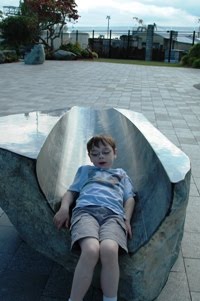
Will's best interpretation of Grandpa Doug being able to fall asleep anywhere...even on a granite chair.


Is it just me or does this sculpture make Doug's nose look bigger?


There were lots of cool play things carved from granite. Here is Will on a slide.


Liann in a rare moment of inactivity.
Like most western Washington communities, the Bremerton area's first economic activities centered around the timber and lumber industry. In 1891, Navy Lieutenant A.B. Wyckoff purchased 190 acres of waterfront on Sinclair Inlet, part of which was owned by the Bremer family. This $9,512 purchase provided the initial land and water access for what is now home to the oldest naval installation on Puget Sound.

William Bremer, a forward-looking German immigrant, realized the economic potential of founding a town so close to the naval station and platted the town of Bremerton in 1891. It was later incorporated in 1901. Through Bremer's promotional efforts, businesses and families were encouraged to locate in Bremerton and provide the goods, services and manpower required to operate the naval shipyard.
Both the City of Bremerton and the Puget Sound Naval Shipyard have changed dramatically since these humble beginnings. The Trident era and resulting development of the Naval Submarine Base at Bangor brought new families to the central Kitsap area, and a major shopping center was developed in Silverdale. Puget Sound Naval Shipyard has experienced an increase in home-ported ships, as well as an increase in the work load as other bases around the country are experiencing military downsizing.
Bremerton's central business district saw a reduction of major retail sales in the 70's and 80's. Since 1990 however, Bremerton has experienced an exciting resurgence of growth and revitalization. New businesses, a new boardwalk, the USS Turner Joy, the Bremerton Marina, and an overall mood of pride and progress

Bainbridge Island - Poulsbo 7/3/10

A charming Norwegian inspired town.


A yacht basin is an essential ingredient in every town on the island.


Like Catonsville they were celebrating the 4th on the 3rd.


Doug and Greg looking very manly.


You can catch almost everything imaginable! We had never seen so many oyster shells and they were all huge.


Now for your history lesson.

Poulsbo's strong Norwegian heritage began over 100 years ago in the late 1880's. Jorgen Eliason is credited with founding Poulsbo. Jorgen, his sister Rakel and his 6 year old son E.J. came to Poulsbo from Fordefjord, Norway, by way of Michigan in 1883. A month after Jorgen's arrival, Ivar B. Moe with his wife and three sons arrived from Paulsbo, Norway, via Minnesota. They settled at the head of the bay to develop a farm on land that has since become Poulsbo Village Shopping Center. Because of it's majestic snow-peaked mountains and fjords, Poulsbo was soon settled by many more Norwegian and Scandinavian immigrants who likened the landscape to their beautiful Norway.

For many years, Norwegian was the only language spoken by the citizens of Poulsbo. In 1886, Ivar B. Moe felt there was enough people on Dogfish Bay (later named Liberty Bay) to warrant a post office. He made an application and called the new town Paulsbo. The Postmaster General misread Moe's handwriting and listed the new post office as Poulsbo. Transportation in Poulsbo's early years was by boat, horseback and foot. Major buying and selling was via a boat trip to Seattle's Pike Place Market.

Fisherman from the Bering Sea brought their catch of codfish here for salting and preserving----one of the largest codfish processing plants in the Northwest. It was also here that lutefisk was processed. Townspeople and visitors can still eat lutefisk at the First Lutheran Church's annual Lutefisk Dinner the third Saturday of each October. This church, founded by those early Norwegian settlers, sits on the bluff overlooking Poulsbo. Service is held in Norwegian each year during Viking Fest.

A "mosquito fleet" of steamers sailed from Seattle to Poulsbo for some 60 years, carrying passengers and freight. Poulsbo's strong ties to the water is still evident today, with the presence of three marinas on the shore of Liberty Bay.

The downtown waterfront area was at one time part of Liberty Bay. In the 1950's the community worked together to fill part of the bay to form Liberty Bay Waterfront Park and Anderson Parkway. Some of the buildings you see today were once on pilings. The Kvelstad Pavilion, a popular spot for summer weddings and family gatherings, was added to the waterfront park later. Within a span of five generations, Poulsbo has changed from a rowboat on an untouched shore to a thriving community with "small town" charm.

Bainbridge Island - Winslow 7/3/10

Entering Bainbridge via the town of Winslow on the ferry from Seattle. It is about a 30 minutes trip and has become a bedroom community for many people who work in Seattle.


Some of the lovely homes in Winslow.


The yacht basin.


Doug, Will and Liann enjoyed shelling and eating the fresh peas that we picked up at the local farmer's market.

Judy and Toddie supported the local economy by shopping at a fabulous yarn store.


Judy continues her fascination with fern fronds.


At little bit about the island for those that are interested.

Captain George Vancouver sailed his ship the HMS Discovery into Puget Sound in 1792. He anchored on the tip of Bainbridge Island at Restoration Point, which is now the Country Club. He named the point for King Charles, who had been "restored" to the throne of England. During much needed ship repair, Captain Vancouver and his men spent two weeks exploring and trading with the Native Americans.

In 1842, Bainbridge Island was visited by white men - English again - when John Work was exploring for a trading post for the Hudson's Bay Company.

In 1841, Captain Charles Wilkes was commissioned to explore the Puget Sound Region for the United States Government. He named the Island for Captain William Bainbridge, an American naval hero in the War of 1812. (In the 1920's, a descendant of Captain William Bainbridge lived in Winslow - Helen Bainbridge Yerkes.)

The Donation Land Claim Law in 1850 which granted 640 acres to a married man, and 320 acres to a single man, brought settlers to the area in search of a place to make their homes. (This, before any settlement was made with the Native Americans of the area.) After Captain Wilkes published his Narrative, many Easterners came west for timber to build ships and establish mills, especially New Englanders. One such New Englander, Mr. George A. Meigs, located his mill at Port Madison, thus beginning the commercial development of Bainbridge Island. It has been said that people would travel by boat from the small village of Seattle to purchase goods from the fine shops in the city of Port Madison. Another man, Captain William Renton, chose Port Blakely as the site for his mill. As wood was in great supply all over the world, logging was very profitable and employed many people, including Native Americans Japanese, Filipino, and Chinese.

In the early 1900's, after the land was cleared, many families had farms and grew a variety of crops which include small fruits, hops and strawberries. Bainbridge berries were the best and commanded the highest prices. The Japanese American and Filipino Community have always been a great influence on Bainbridge Island; their strawberry farms were the benchmark of the industry in their day. After WWII, much of the farming was discontinued.

July 2, 2010

On the evening of July 1st we returned to lovely Whitefish, MT. Prior to getting on the train we had a couple of excellent drinks at the Craggy Creek (they get our unanimous vote for the best libations thus far). The train left at 9:16P so we pretty much made our way to our spacious accommodations and retired for the evening.

We disembarked the Amtrak Empire Maker in Seattle around 9:30A on the 2nd. Regaining one's land legs and basic equilibrium after lying in the sleeper car for many hours is somewhat tricky (it may have had something to do with the tasty cocktails too).

After reclaiming our luggage we caught a cab to 1919 N. 5th Ave. in lovely Seattle to pick up our rental car and easily found our way to the interstate and ultimately Snoqualmie Falls...the home of Toddie, Greg, Will and Liann Downs.

It was a cold and gray day. We pretty much stuck around the house watching the kids do the amazing things that kids do to keep us adults entertained. Liann and Will provided us with a lovely recital on violin and piano respectively. In addition we received a crash course in how to play a couple of Wii games. We eventually braved the elements and took a walk before ending up at Starbucks for an afternoon snack. For dinner Greg grilled some beautiful steaks to accompany Toddie's salad. We retired early because tomorrow we are off to Bainbridge Island via the ferry.

I thought some of you might be interested in learning a little bit more about Snoqualmie Falls. Several thousand years ago, when the glaciers receded, they left a fertile plain near Snoqualmie Falls. When Native Americans arrived, they found a bounty of edible bulbs, roots and berries on the prairie. Deer and mountain goats were plentiful.

Though there were no salmon above the falls, the upper Snoqualmie River became a seasonal rendezvous and meeting place as trade among native peoples increased. The Snoqualmie Tribe (a subgroup of the Coast Salish) established a camp at the base of Mount Si. They also established villages at Fall City and Tolt (Carnation). Snoqualmie is the English pronunciation of "sah-KOH-koh" or "Sdob-dwahibbluh," a Salish word meaning moon.

As a spiritual place, it gave birth to many legends. One tells of "S'Beow" (the beaver), who climbed into the sky to bring trees and fire down to earth. The Native Americans who roamed the valley were known as people of the moon.

White settlers began to arrive in the valley by the early 1850s. Long before, the falls became a tourist destination; pioneer women would edge as close to the falls as they could while friends held on to their dresses to keep them from falling. Jeremiah Borst was the first permanent white settler in the Snoqualmie Valley and is known to some as "the father of the Snoqualmie Valley."Josiah Merrit ("Uncle Si") built a cabin at the base of a local peak in 1862 (the peak became known as Uncle Si's mountain -- now Mount Si). He raised vegetables and hogs and kept an orchard. According to local historians, he was a rugged man who sometimes hauled bacon to the large settlements. To do so necessitated hauling the load on a sled to the river, canoeing downstream, strapping the load to his back and climbing down the 268-foot falls, hiking several miles, and then canoeing the rest of the way to Everett or Seattle.

By 1877, there were several logging operations in the region. In early days, logs were floated over the falls and down the river to Everett and Puget Sound. By 1889, entrepreneurs funded and built a railroad (the Seattle, Lake Shore and Eastern) into the valley, opening up timber resources to the world market.

In 1889, the town of Snoqualmie was platted by Charles Baker, a civil engineer. He also constructed an underground power plant at the falls in the 1890s (those original generators are still functioning today). The power plant resulted in electricity and jobs for locals, and soon a small company town was established at the falls. In 1911, a second powerhouse was constructed.

Such large waterfalls often attract daredevils. When that first passenger train arrived in 1889, it was a big event -- more than 1,000 people turned up for food, celebration and entertainment. A Mr. Blondin successfully walked a tightrope over the falls.I n 1890, Charlie Anderson was less fortunate. He parachuted into the canyon from a hot-air balloon, but when he opened the chute a strong air current pushed him toward the falls. As the crowd watched in horror, another gust pulled him in another direction and dropped him on a large boulder; he died that night.

Alisha's Graduation Celebration

Remember how you felt when the "good old golden rule days" of high school were behind you? I think Alisha's face says it all.


No Soule gathering would be complete without music. Here are Toddie and Tim (Doug's daughter and son) doing some picking.


Toddie was later joined by Willie, a fantastic autoharpist.


What's a party and campfire without S'mores?


Johnny, Tim, Alisha and Doug Soule.


July 1, 2010 Kalispell and Big Fork, MT

I had read in a local travel magazine that the best views of the Flathead Valley can be seen from Lone Pine State Park. We drove up there on July 1st just as a fairly impressive storm was moving in over the northeastern part of the valley.


This is from Lone Pine State Park looking south towards Flat Head Lake.


One of our favorite towns is Big Fork, MT which is located on Flat Head Lake. This shot of Doug's is representative of the downtown area.


These last two shots were taken in the early evening as we were preparing to drive up to Whitefish to catch the night train back to Seattle. These are canola fields and they really are this bright yellow. The evening sun really illuminated the flowers.